

 By
By I am not against anything,” says Berlin-based artist Anja Ibsch, pausing between yet another reconfiguration of her installation at the Kochi-Muziris Biennale.
The statement, delivered with calm assurance, is less a defence than a philosophy, one that frames her quietly radical presence at India’s most significant contemporary art exhibition.
The artist, whose work has been unfolding daily at the Biennale venue, has chosen impermanence as both method and message. Unlike the static certainty of a painting fixed to a wall, Ibsch’s installation changes every day, sometimes subtly, sometimes dramatically.
Objects are moved, materials rearranged, gestures repeated or withheld. For visitors returning on consecutive days, the work never quite settles into familiarity. It resists being fully seen, insisting instead on being experienced in time.
By altering the installation each day, Ibsch says she wants to convey the transient nature of life itself. Nothing, she suggests, remains constant, not the body, not memory, not even meaning.
In a city like Kochi, where layers of history coexist with relentless change, the idea finds a natural resonance. The Biennale, spread across old warehouses, colonial structures and
waterfront sites, already carries a sense of flux. Ibsch’s work intensifies that awareness, drawing attention to the fragile present moment.
Ibsch has been actively working as an artist and curator in the fields of performance art and installation since 1993. Over more than three decades, she has developed a practice that is both physically demanding and conceptually rigorous. Her works explore personal, cultural and social aspects of human presence, often through the direct use of her own body.
Endurance, pain, physical strength and vulnerability recur as motifs, not for spectacle, but as tools of inquiry.
Characteristically, the artist tests her bodily limits, creating images and situations that merge conceptual concerns with tasks of physical intensity. For audiences, these moments can be unsettling, even confronting. The body is not presented as a stable identity but as something mutable, responsive and, at times, fragile. In this way, her performances and installations transform how viewers understand the performer’s physical presence, shifting perception from observation to empathy.
At the Biennale, this sensibility translates into an installation that refuses closure. Ibsch creates her work in response to the circumstances that present themselves, adapting to local environments and situations. Light, humidity, spatial constraints and audience movement all play a role in shaping the daily changes. The work becomes a dialogue between artist, site and time, rather than a finished object to be consumed.
Her remark that she is “not against anything” gains deeper meaning in this context. It is not indifference, but openness. Ibsch does not position her practice in opposition to painting or permanence; instead, she proposes another way of thinking about art, one that mirrors the instability of lived experience. In doing so, she aligns closely with the Biennale’s broader interrogation of history, body and place.
As visitors navigate Kochi’s labyrinthine venues, Ibsch’s evolving installation offers a reminder that art, like life, is never fixed. It exists in moments, in transitions, and in the quiet acceptance of change.
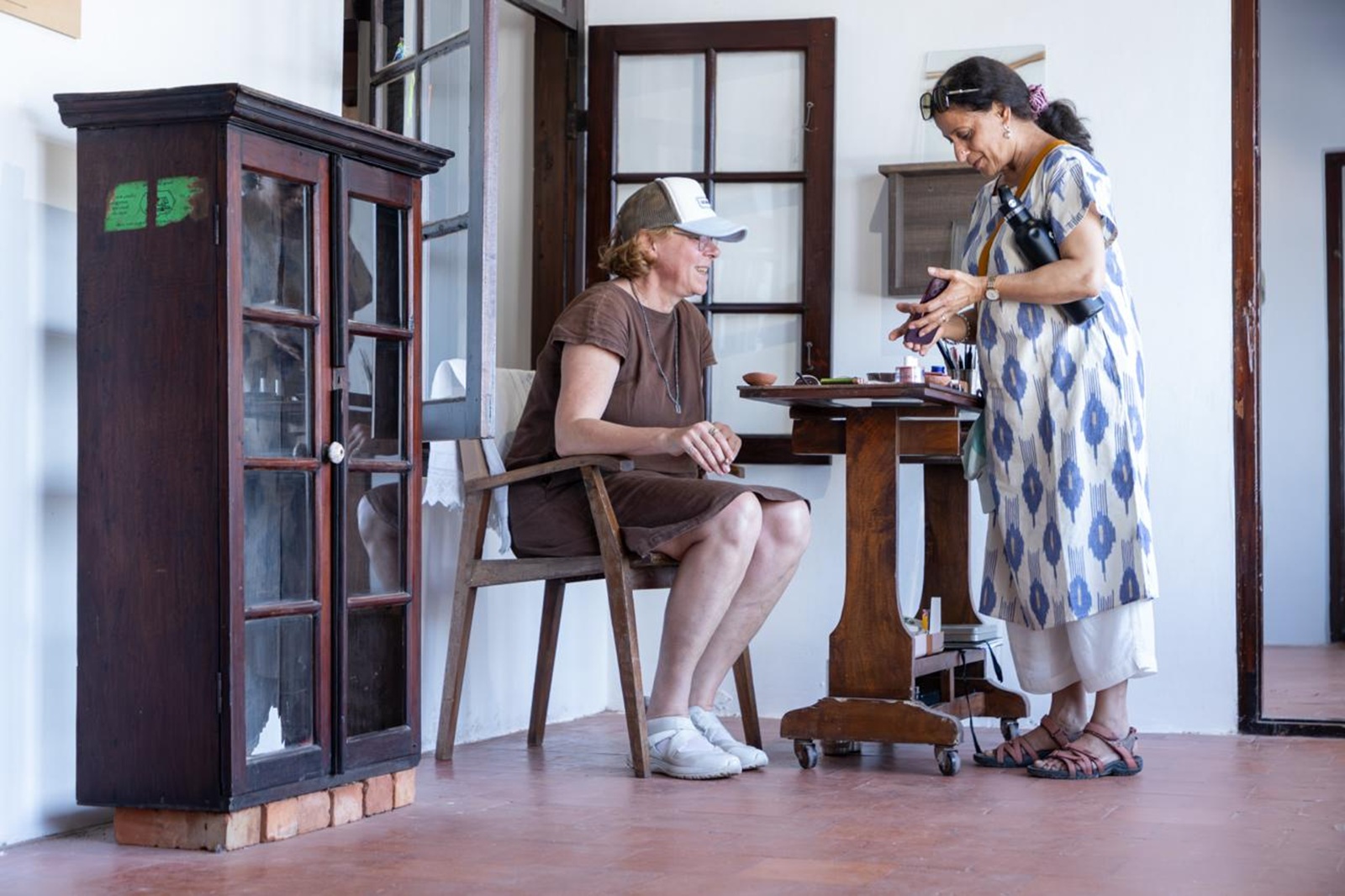
Ibsch will be at the Aspinwall venue, quietly seated on a chair outside the room that overlooks the waterbody, where ships and boats constantly criss-cross. With her tools laid out on a table, she works patiently, often preparing elements for the next day’s installation, while occasionally engaging in conversation with curious visitors. She will remain here for the entire duration of the Biennale.