
 By
Startups seeking to do business with India’s large conglomerates need more than promising ideas. They must demonstrate how their solutions address specific business requirements, establish product feasibility and show the potential to evolve into commercially viable offerings, industry leaders said during a panel discussion at Huddle Global.
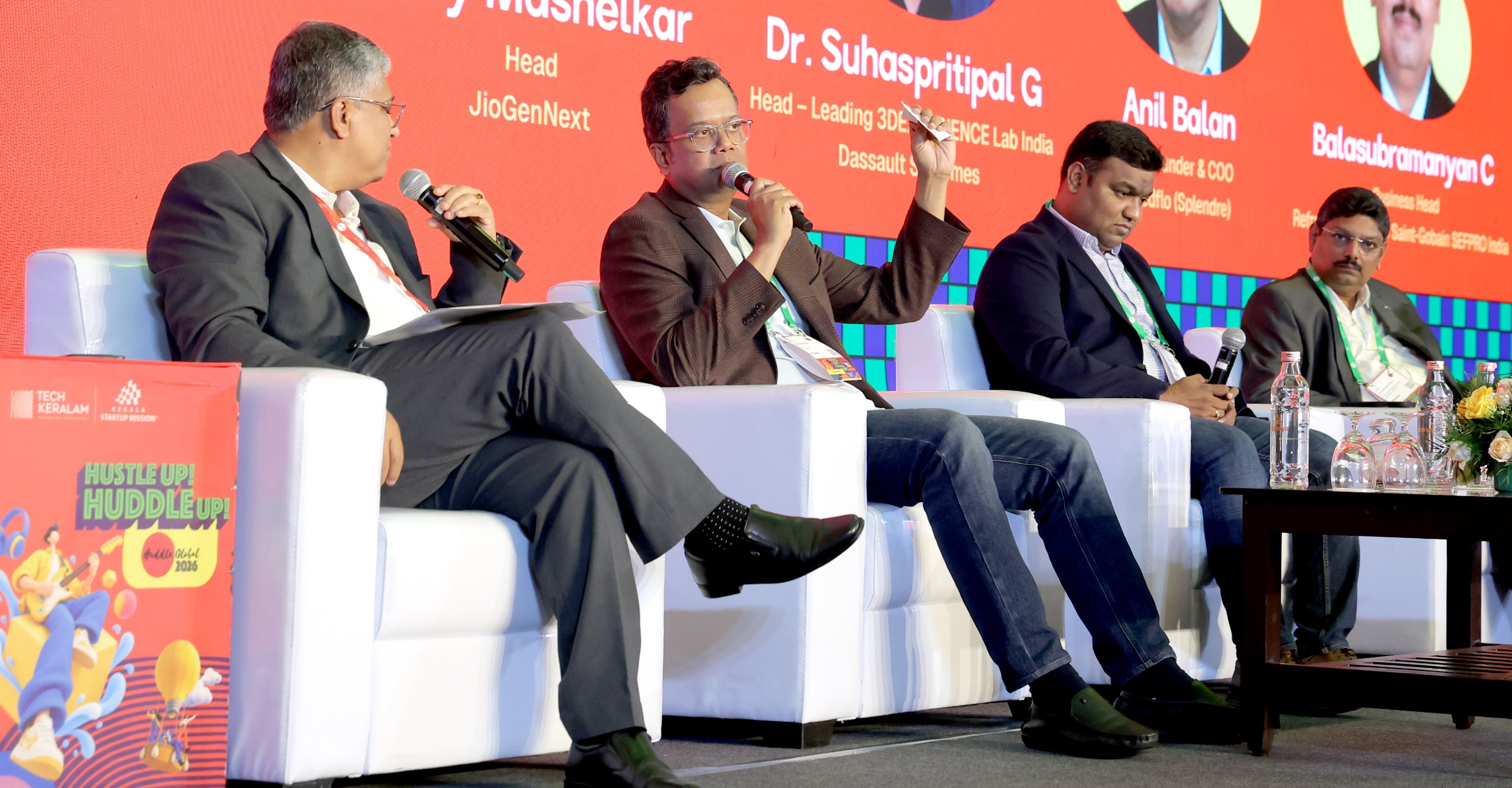
The discussion, titled Cracking India’s Conglomerates: From Proof of Concept to Purchase Order, was chaired by Anil Balan, Co-founder and CEO of Kredflow (Splendre), at Huddle Global, the three-day annual startup summit organised by the Kerala Startup Mission (KSUM), which began here on Thursday.
C. Balasubramanyan, Business Head, Refractory Business, Saint-Gobain SEFPRO India, emphasised the need for startups to align their solutions with the business requirements and technological priorities of potential corporate partners.
He said companies need to ensure that proposed solutions are relevant to their areas of operation, citing aerospace as an example. Corporates must also have the appropriate technical teams to evaluate the technology and work alongside startups.
Balasubramanyan said corporates are willing to work with startups to enhance existing products by adding capabilities, technologies and improvements to develop complete and sustainable solutions. However, he stressed that startups must have a tangible product to demonstrate rather than approach companies with an idea alone.
Amey Mashelkar, Head, JioGenNext, highlighted how startups at different stages of development could find opportunities within large corporate ecosystems, provided their solutions address relevant business needs.
Citing an example, he recalled a startup that approached the organisation with a spreadsheet to demonstrate a proposed software solution for account reconciliation between marketplace and retail operations.
The founders used the spreadsheet to explain how the eventual software would function. The company has since grown into a fully scaled-up business, with products serving markets in India and internationally.
According to Mashelkar, the example illustrates that corporates can evaluate startups across different stages of maturity, from early-stage concepts to established businesses.
He said the deciding factor was the relevance of the solution to the corporate’s business context. Whether the opportunity lies within Reliance Retail, Jio’s telecommunications business or another function within the group, JioGenNext is open to evaluating solutions that address identifiable business opportunities.
Dr Suhaspritipal G, Head, Leading 3DEXPERIENCE Lab India, DassaultSystèmes, outlined how startups could improve their chances of securing corporate partnerships through structured engagement and stronger product presentations.
He encouraged startups to explore corporate engagement programmes and events, including hackathons, noting that many large organisations provide online application channels for startups. Understanding individual corporate selection criteria is equally important, he said.
He stressed the need for clarity on a product’s objectives, architecture and competitive advantages when approaching potential corporate partners.
Technology tools such as computer-aided design (CAD) and product lifecycle management (PLM) software can help startups simulate products and develop virtual models before physical production. Such capabilities allow founders to assess product feasibility and demonstrate its potential to prospective corporate partners.
DrSuhaspritipal said credibility gained through corporate associations could also strengthen a startup’s position when approaching investors. Evidence of corporate engagement or validation can help demonstrate that a solution has been evaluated by an established organisation, potentially increasing investor confidence.
He urged startups, including smaller enterprises, to explore opportunities beyond their home markets and communicate their products, objectives, investments and business propositions transparently.
The discussion highlighted that securing a purchase order from a large conglomerate is not necessarily a straightforward progression from pitching an idea. Startups need to establish business relevance, demonstrate technical capabilities, remain open to product development and build relationships with the right corporate teams.
In a keynote address, Suresh Khadakbhavi, CEO of the DigiYatra Foundation, said trials of international travel services powered by the DigiYatra system have begun at some of India’s major airports.
The international travel trials are currently under way at seven major airports across India, he said.
He was talking about the global opportunities that airports and digital platforms can offer startups.
Khadakbhavi added that DigiYatra aims to drive positive transformation in the aviation sector and enhance the passenger experience at airports.